
Balochistan is land of resources and minerals. It is full of beauty and having very important geo strategic importance. Balochistan is a strategically important region due to its location at the crossroads of South Asia, Central Asia, and the Middle East.
It provides Pakistan with a long coastline along the Arabian Sea, making it vital for maritime trade and energy routes. The Gwadar Port in Balochistan is a key deep-sea port under the China–Pakistan Economic Corridor (CPEC), linking China to the Arabian Sea. It also sits near important global shipping lanes, especially the Strait of Hormuz, through which a large share of world oil passes.
Balochistan is rich in natural resources, including copper, gold, coal, and natural gas. The Reko Diq area is one of the world’s largest undeveloped copper and gold deposits. Sui gas fields have historically contributed significantly to Pakistan’s natural gas supply. Because of these resources and its location, Balochistan holds major economic and geopolitical significance for both Pakistan and the wider region. There are no reliable data or statistics about these all resources of Balochistan that what is produced in one year and how much is earned out of it?
Due to all this situation in Balochistan, the issue of enforced disappearances is closely connected to the province’s long history of political unrest, separatist insurgency, military operations, and demands for greater political and economic rights. The conflict intensified after the early 2000s, especially following the killing of Nawab Akbar Bugtiin 2006, which became a major turning point in Baloch nationalist politics and armed resistance.
Many families in Balochistan claim that students, political workers, social activists, journalists, teachers, and ordinary civilians were picked up by unidentified or security-linked personnel without warrants or formal charges. Reports often describe individuals being taken from homes, checkpoints, universities, hostels, or public places. In many cases, relatives state that they were unable to obtain official information about where the individuals were being held or whether they were alive or not.
Districts frequently mentioned in reports and protests include:
Student organizations and nationalist groups have repeatedly alleged that educated Baloch youth were particularly targeted due to suspicions of political activism or links with separatist movements. At the same time, the state argues that militant violence, attacks on security forces, and separatist insurgency created serious security challenges requiring extensive counterterrorism operations.
Another deeply controversial aspect is the issue commonly referred to as “kill and dump.” Human rights groups and families have alleged that, in some cases, bodies of previously missing persons were later found in remote areas. Even their bodies are brutally mutilated with sharp objects, their bones broken, and their eyes gouged out. Authorities have denied involvement in unlawful killings and often attribute violence to militant infighting or terrorism related conflict. This remains one of the most disputed dimensions of the conflict.
Families of missing persons have organized some of the most visible protests in Pakistan. Groups such as the Voice for Baloch Missing Persons (VBMP) have staged long sit-ins and marches demanding,
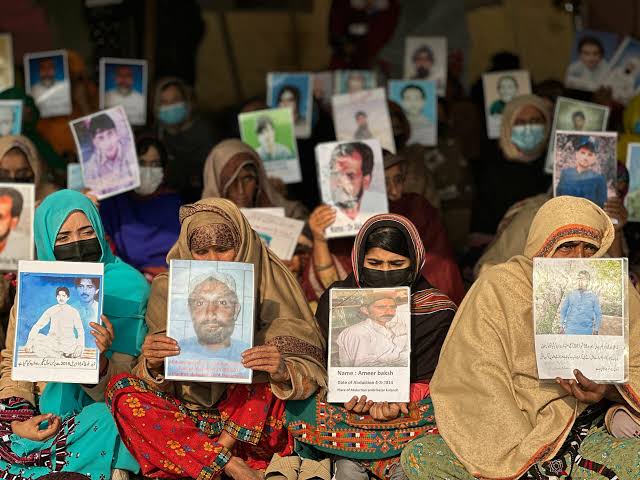
Along with them Baloch Yakjaithi Committee BYC also emerged to protest against these disappearances and extra judicial killings and marched from Kech to Islamabad when Balach Baloch a young boy along with a friend was murdered in a fake encounter. Different political parties as well raise the issue time to time for highlighting human rights issues and loopholes and for political gains including those who call themselves as National parties. A major symbol of these protests has been the long camp maintained by relatives of missing persons in Quetta for many years. Families, including mothers, sisters, and children, have publicly displayed photographs of missing relatives to seek attention from the government, courts, media, and international organizations.
The Supreme Court of Pakistan has periodically taken notice of forcefully disappeared cases in Balochistan. Hearings have included criticism on law enforcement agencies, requests for reports, and directions to provincial and federal authorities. The Commission of Inquiry on Enforced Disappearances was also established to register and investigate complaints. According to official statements, many cases have been traced or resolved, though families and activists argue that thousands remain unresolved or inadequately investigated. But the reality on ground is total different. Many cases are pending with no results. In many cases the production orders were issued with no actions on it.
The issue also has a psychological and social impact on families. Many relatives live for years without confirmation whether loved ones are alive or dead. Children grow up without parents, and wives spent the life like widows for years with now answer about their forcefully disappeared husbands. Families often face economic hardship, trauma, social pressure, and fear. In several cases, families say they hesitate to speak openly due to security concerns or fear of further repercussions.
International organizations including Amnesty International and Human Rights Watch have repeatedly called for transparent investigations, due process, and accountability. Meanwhile, Pakistani authorities maintain that many allegations are politically motivated or linked to the broader insurgency and security environment in the province.
Today, enforced disappearances remain one of the most emotionally charged and politically sensitive issues in Balochistan, reflecting the wider tensions between security policy, human rights concerns, ethnic identity, and demands for political inclusion.
Enforced disappearances have become one of the most controversial and painful human rights issues in Balochistan. For hundreds of families, the disappearance of a loved one means the loss of peace, security, and emotional stability. Parents, spouses, siblings, and children continue to wait for years without any official information regarding the whereabouts or legal status of their family members.
National and international human rights organizations, civil society groups, and victims’ families have repeatedly raised concerns over alleged enforced disappearances, extrajudicial killings, and arbitrary detentions in the province. Despite years of protests and legal petitions, many families claim that justice remains inaccessible.
The Government of Pakistan established the Commission of Inquiry on Enforced Disappearances (COIED) to investigate missing personscases. However, human rights organizations and victims’ families have frequently criticized the commission for its limited effectiveness, delays in investigations, and inability to provide accountability. Families of missing persons have also alleged intimidation and harassment while pursuing legal remedies.
According to many families and human rights activists, Joint Investigation Teams (JITs), comprising officials from multiple security and law enforcement agencies, investigate disappearance cases even when those same institutions are alleged to have conducted the arrests. Critics argue that this creates an inherent conflict of interest and undermines public confidence in the investigative process.
Families have also alleged that they are pressured to publicly distance themselves from missing relatives or declare that they voluntarily joined militant organizations. Some families further claim that they are threatened with the arrest of other relatives or administrative restrictions, including inclusion on the Fourth Schedule, resulting in blocked bank accounts, SIM registrations, identity documents, and travel restrictions. These allegations require independent investigation and judicial oversight.
The humanitarian consequences of enforced disappearances extend far beyond the missing individual. Families experience psychological trauma, financial hardship, social isolation, and uncertainty that can last for decades. Mothers, fathers, wives, and children often continue searching for answers without knowing whether their loved ones are alive, detained, or deceased.
In the past six months if we see the statistics which are reported by Baloch Human Rights Council (BHRC), shows that in the month of October, 2025 113 persons were abducted and 31 killed including 2 women. In the month of November, 106 disappeared and 42killed out of which 3 were women and remain unidentified till last. In the month of December, 90 were forcefully disappeared and 19 were killed. In 2026 January, 107 were disappeared on force and 78 killed including 1 woman. In the month of February, 234 were disappeared and 87 were killed including 5 women in different incidents. In the month of March, 65 were disappeared and 50 were killed which is very high number. These all figures show very serious security concerns and lack of obligations to secure human rights in Balochistan.
Many families along with their females are coming emotionally broke to give statements to be in touch with their sons in case they have any affiliation in any armed organization. Despite of hundreds of hundreds of such press conferences, mother of Bilal Shawani along with his two brothers and cousins are picked on gun point from their homes after the 24th May, 2026 self-suicidal attack on train on Chaman patak Quetta. The family held a press conference on 22nd February, 2026 and mentioned the amendment with their son. As per the constitution of Pakistan, any individual who is 18years is responsible for their deeds and agreements. Still the families are held accountable for their sons who are already have taken their decision about their lives.
A thorough and compressive study needs to be conducted by International Human Right organizations to unfold the untold stories and sufferings of the people of Balochistran. Those people who are robbed in daylight by the Law Enforcement Agencies who are supposed to safeguard them. They are the ones who take all their assets, in case they can not take they destroy those all means of survivals. In Makrantrees of dates along with different crops so the natives can be forced to knee down in front of them or just to leave their homes and move from there. The videos and pictorial evidences of such incidents are present but still there is no say on these nor from national or international level. Those who raise voice are forcefully disappear or killed or sent to jail with no any legal justification like case of Iman Mazari and Haddi Ali or Dr. Maharang and her companions. A press conference was held in Gawadar press club by Molana Hidat Rehman. He mentioned that we welcome those all who are on mountains. They come back and become part of the main stream with state, do the politics on roads and in assemblies. But the one who were on roads are now behind the bars.
In this country it is near to impossible to talk about basic human rights. Even though Pakistan is signatory of Human Rights declaration which is just a piece of paper for those who were supposed to be custodian of the same.
In this entire situation Baloch has to be clear about their path and coming generations to lead for a sovereign state.


Add comment